Projects
Project 1 – Epigenetic and systemic mechanisms of rejuvenation of aged stem cells
As we age, the intrinsic ability of stem cells to self-renew and differentiate to maintain tissue integrity dramatically declines. Therefore, understanding the processes leading to stem cell dysfunction with age is essential for the future development of novel, effective stem cell-based therapies to treat disorders associated with aging. Therefore, my long-term goal is to elucidate the epigenetic mechanisms of stem cell aging, manipulate them to rejuvenate aged tissue, and promote healthy aging. More specifically, the insight provided by this proposal would be used to devise strategies to rejuvenate muscle and hematopoietic stem cell function, and therefore promote skeletal muscle recovery and reduce age-associated systemic low- grade chronic inflammation. To accomplish this objective, we will utilize mouse genetic models, models of skeletal muscle degenerative injury and moderate exercise (voluntary wheel running; VWR), cell culture systems, imaging analysis, small molecule inhibitors, flow cytometry analysis, physiological measures of recovery, genomics, and epigenomics (Cleavage Under Targets and Tagmentation; CUT&Tag). In aged mice, both muscle stem cell (MuSC) and hematopoietic stem and progenitor cell (HSPC) quiescence is disrupted, leading to reduced regenerative capacity. Recent studies used VWR to restore quiescence and rejuvenate both MuSC and HSPC function in aged mice. The epigenetic landscape in both stem cell populations changes dramatically, yet the mechanisms underlying these events as well as their contribution to age-associated dysfunction remain understudied. The lysine methyltransferase 5a (Kmt5a) is the sole enzyme catalyzing monomethylation of lysine 20 on histone H4 (H4K20me1), which is required for subsequent di- and tri-methylation by Kmt5b and Kmt5c, respectively. Methylation of H4K20 is critical for chromatin organization and regulation of transcription, yet its role in adult stem cells is entirely unknown, especially in the context of aging. Our preliminary data show that Kmt5a and H4K20me1 decrease in aged MuSCs. Specific deletion of Kmt5a in MuSCs recapitulates aging phenotypes by decreasing the pool of stem cells, suggesting disruption of quiescence and impaired self-preservation of the pool. Using the recently developed epigenomic technique CUT&Tag, we assessed H4K20me1 in adult and aged quiescent MuSCs and found that H4K20me1 is mostly located at the genes’ transcriptional start site and significantly decreases with age. Further analysis revealed that age-associated loss of H4K20me1 silenced numerous Notch genes including Rbpj, critical to maintaining MuSC quiescence. Significantly, Kmt5a inhibition and subsequent loss of H4K20me1 in MuSCs led to decreased RNA Polymerase II serine 2 phosphorylation, suggesting the impaired release of promoter-proximal pausing and therefore potent gene silencing. Thus, we propose to examine if the loss of Kmt5a, and consequently H4K20me1, in aging MuSCs contributes to the disruption of their quiescence state. Also, we will determine the role of Kmt5a in regulating RNA Polymerase II promoter-proximal pausing, and how this proposed mechanism contributes to controlling MuSC fate and function. Last, we will determine if moderate exercise using a VWR model can rejuvenate MuSC and HSPC epigenome through the restoration of H4K20 methylation. The specific aims of this proposal are: 1) Determine the role of Kmt5a in MuSC quiescence regulation during aging and 2) Determine the impact of VWR on Kmt5a-mediated epigenetic remodeling in aged MuSC and aged HSPC.

Funded by NIA/NIH R00AG071736
Project 2: Iron Metabolism, Ferroptosis, and Epigenetic Mechanisms in Stem Cell Aging
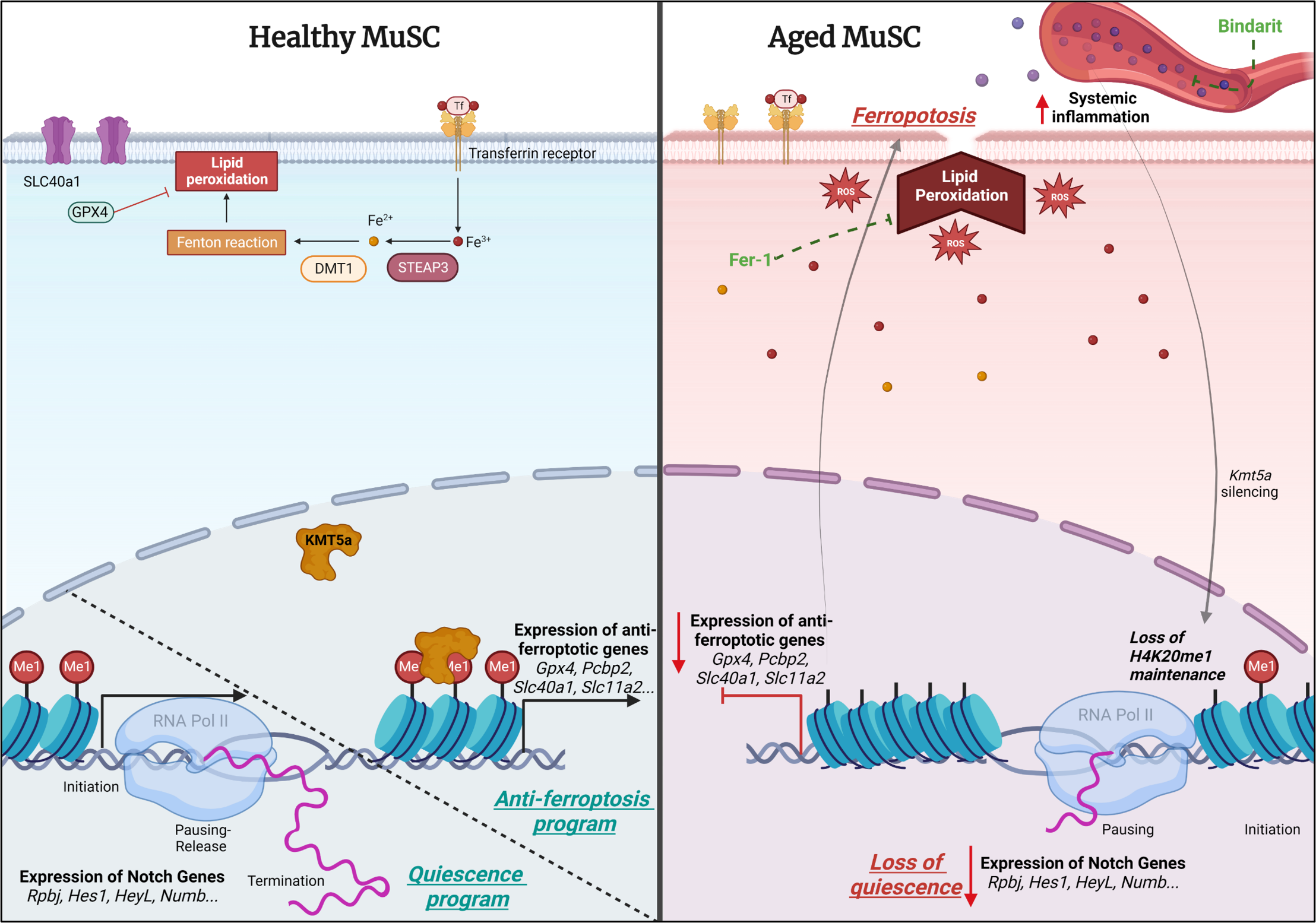
This project investigates how aging affects stem cell function, focusing on the complex interplay between iron metabolism, ferroptosis, and inflammation. Our goal is to uncover the molecular and epigenetic changes that drive stem cell aging, particularly in Muscle Stem Cells (MuSCs), and to explore how iron dysregulation accelerates this process.
Aging is accompanied by a progressive decline in stem cell functionality, often linked to increased inflammation and changes in iron metabolism. In this project, we are studying how these systemic factors influence MuSC fate decisions by remodeling their epigenetic landscape over time. Our recent findings revealed that age-related inflammation triggers the loss of H4K20me1, an epigenetic mark critical for maintaining MuSC quiescence. The erosion of this mark results in the silencing of key genes, which leads to ferroptosis—a specific form of iron-dependent cell death.
We have shown that ferroptosis is a dominant form of cell death in several aged stem cells. This form of cell death is closely tied to abnormal iron metabolism, with aged cells accumulating excess iron and exhibiting oxidative damage. By targeting the systemic inflammation and iron dysregulation that drive ferroptosis, we were able to prevent stem cell loss and restore regenerative capacity in aged mice, resulting in improved muscle repair and extended healthspan.
Through this work, we aim to identify novel therapeutic targets to rejuvenate aged stem cells, protect against iron-induced damage, and ultimately improve tissue regeneration and healthy aging. This project provides an exciting opportunity for students interested in the intersection of stem cell biology, epigenetics, and aging research.
See the pre-print now!